
Still unsure which region?
A few questions, under three minutes, and a French destination that matches what appeals to you.
Let’s be honest: the first time you open a map of Paris to look for accommodation, you usually just want to close the tab.
It’s overwhelming. Between the 20 arrondissements (which form that strange snail shape) and the eye-watering prices (we won’t lie to you), Paris is expensive. Add to that the terrifying fear of booking a “gem” that turns out to be above a noisy bar or an hour’s metro ride from the Eiffel Tower, and the pressure rises quickly.
And that’s normal. Because in Paris, your address changes everything.
Sleeping in the Marais versus staying near a poorly connected “Porte de Paris” (city gate) isn’t just a difference in budget. It’s the difference between going downstairs to enjoy a coffee on a terrace like a true Parisian, or starting every day with 45 minutes of crowded public transport (the famous rush hour metro experience you could really do without).
I’ve seen too many travelers spoil their first trip simply because they underestimated the city’s geography. So, let’s clear the ground together. Forget real estate jargon and dusty tourist descriptions: I’m going to explain Paris to you the same way I explain it to my friends when they come to visit. We’re going to find the neighborhood that suits you.
Table of Contents
Understanding the Geography Before You Book
Before we talk about hotels or Airbnbs, we need to talk about the snail.
Yes, the snail. That’s how we visualize Paris. The city is divided into 20 arrondissements (districts) that spiral out in a clockwise direction, starting from the center (the 1st arrondissement, where the Louvre is located).

As you can see on the map below, the lower the number (1st, 2nd, 3rd, 4th…), the deeper you are in the historic and geographic heart of the city. As the number gets higher (12th, 15th, 19th, 20th…), the further you move toward the periphery, known as the “Portes de Paris” (Gates of Paris).
But be careful, don’t let the size of the map fool you: Paris is a surprisingly small city (especially compared to London or Berlin). You can walk across several arrondissements without even realizing it, just by crossing the street.
Roughly speaking, the Seine cuts the city into two vibes:
- Left Bank (South): This is the historic side, the romantic cliché, university hub (Sorbonne), and very chic (Saint-Germain). It is generally quieter.
- Right Bank (North): This is the vaster side, blending business, department stores, and trendy, working-class neighborhoods. This is where the nightlife happens.

The Postal Code Trick
Here is a foolproof way to know where your accommodation is located in the blink of an eye. Look at the last two digits of the postal code.
75001 = 1st arrondissement.
75018 = 18th arrondissement.
If the code doesn’t start with 75, you aren’t in Paris proper (intra-muros), but in the suburbs (and travel times will change radically).
How to Choose Where to Stay in Paris for First Timers
If you ask three Parisians what the best neighborhood is, you will get three different answers (and probably a heated 20-minute debate). Why? Because the best spot depends entirely on your style of travel.
To avoid making a mistake, you need to balance three criteria: your budget, your desires, and—the point often overlooked—logistics.
1. The Sinews of War: Budget vs. Reality
Let’s be clear from the start: staying in Paris is expensive. It is often the biggest expense of the trip.
- If you have a comfortable budget: Aim for the center (1st to 6th). You are paying for the luxury of doing everything on foot.
- If your budget is tight: You will have to compromise. Either on space (the famous “maid’s room” on the 6th floor with no elevator) or on location. And believe me, moving a bit further out isn’t a tragedy, provided you choose your metro line well (I’ll tell you about that in a moment).
Define your Paris accommodation budget and process
Undecided between the center, Montmartre, or a close suburb? Discover our travel design service: we design your trip, you approve the quote, and we handle every booking. Support during your stay is included.
2. The Vibe: Postcard Paris or Local Life?
This is the question I always ask my ItineraryFrance clients: What atmosphere are you looking for when you walk out of the building in the morning?
- History with a capital H: You want to see old stone, monuments at every street corner, and the romantic atmosphere from the movies? Stay on the banks of the Seine (Latin Quarter, Marais, Saint-Germain).
- Neighborhood life (and parks): If you prefer a more relaxed vibe, seeing families in the parks, and eating in bistros where locals have their daily habits, aim for neighborhoods like Batignolles or the 11th. It’s less monumental, but so much more alive.
3. Accessibility: Don’t Count Miles, Count Stops
This is the #1 rookie mistake. You see a hotel 3km from the Eiffel Tower and think it’s far. False!
In Paris, physical distance matters little. What counts is the connection.
- Being at the foot of the Eiffel Tower (in the 7th) is magical for the view, but in the evening, it’s a very quiet, even dead neighborhood (and very expensive), and not necessarily the best served by the metro.
- Conversely, being at République means having 5 metro lines under your feet that take you everywhere in 15 minutes.
Top Neighborhoods: Where to Stay in Paris for First Timers
Now we get to the heart of the matter. For a first trip, I advise against playing the adventurer and booking at random. You need to bet on safe values.
I’ve selected the neighborhoods I recommend most often at ItineraryFrance. This isn’t an exhaustive list (there are gems everywhere), but it’s the “Greatest Hits” to ensure you don’t go wrong.
Here is an overview to help you spot your ideal base camp:
| Neighborhood | Vibe | Close to… | The Atmosphere | Budget | Perfect for… |
|---|---|---|---|---|---|
| Le Marais (3rd/4th) | Trendy, historic & lively | Notre-Dame, Centre Pompidou | The vibrant heart of Paris, where history meets fashion. | €€€ | Couples, shopping, and those who want to walk everywhere. |
| Saint-Germain (6th) | Chic, literary & iconic | Luxembourg Gardens, The Louvre (across river) | Parisian elegance par excellence. Postcard Paris. | €€€€ | Romantic stays and comfortable budgets. |
| Latin Quarter (5th) | Young, intellectual & animated | Panthéon, Jardin des Plantes | A maze of old cobblestone streets full of charm. | €€ | History buffs and students (at heart or in age!). |
| Montmartre (18th) | Bohemian, village & romantic | Sacré-Cœur, Moulin Rouge | A hilltop village frozen in time (warning: steep hills!). | €€ | Dreamers, artists, and those with strong calves. |
| Batignolles (17th) | Village, family & relaxed | Parc Monceau, Arc de Triomphe (nearby) | The art of Parisian living, far from the tourist crowds. | €€ | Families and those who want to live like a local. |
| Canal St-Martin (10th) | Hipster, festive & photogenic | République, Place des Vosges (nearby) | Aperitifs by the water and designer boutiques. | €€ | Groups of friends and cool young couples. |
| Levallois / Clichy (Near Suburbs) | Modern, residential & safe | Metro access to St-Lazare / Champs-Élysées | The pragmatic choice: more space for less money. | € | Tight budgets and families wanting peace and quiet. |
How to read this table?
Budgets are indicative (Paris remains expensive!).
€ = Affordable (for Paris).
€€ = Parisian average.
€€€ = Highly sought-after areas where the square meter comes at a premium.
€€€€ = Very high end.
Now, let’s zoom in on each neighborhood to see which one is made for you.
Le Marais (3rd/4th)
Vibe: Arty, historic, trendy & (very) lively
If you close your eyes and imagine medieval Paris with its narrow streets, cobblestones, and designer boutiques, you are imagining the Marais. It is, without question, the most requested neighborhood by my clients for a first stay.

Why do we love it? It’s the only neighborhood that manages the perfect split: you sleep in 17th-century settings (the famous Hôtels Particuliers) while having the most modern concept stores at the foot of the building. It’s also one of the rare corners of Paris that stays totally awake on Sundays, when the rest of the city is taking a nap.
Practical side & monuments: You are literally in the center of everything.
- To see right there: The sublime Place des Vosges (my favorite picnic spot), the Centre Pompidou (for modern art), and the Picasso Museum.
- A stone’s throw away: You can walk to Notre-Dame, Île Saint-Louis, or the Hôtel de Ville in 10 minutes. The private walking tour of Paris by the river ends in these same streets, once the two islands are behind you.
The budget: €€€ Popularity has a price. Hotels are expensive and rooms are often small (this is old Paris, elevators are sometimes optional!). Airbnb is heavily regulated here, so the supply melts away fast.
Good to know
The Marais is a victim of its own success. On weekends, the main streets (like Rue des Francs-Bourgeois) are packed with people. If you are looking for absolute calm, aim for the Haut-Marais (3rd arrondissement), near the Marché des Enfants Rouges: it’s the same vibe, minus the crowds.
It’s perfect for you if:
- You want to do everything on foot without taking the metro.
- You love shopping, art galleries, and lively terraces.
- City noise doesn’t bother you (it’s lively, day and night!).
Saint-Germain-des-Prés (6th)
Vibe: Chic, literary, iconic & Left Bank
If the Marais is the trendy cousin who goes clubbing, Saint-Germain is the elegant aunt reading a book on a terrace with a glass of champagne. This is where the heart of literary and romantic Paris beats.

Why do we love it? There is a sweetness of life here that you don’t find elsewhere. This is the Paris of Hemingway, Sartre, and de Beauvoir. Even if major luxury brands are gradually replacing bookstores, the soul of the neighborhood remains intact. It’s clean, it’s beautiful, and it’s incredibly safe.
Practical side & monuments:
- To see right there: The Saint-Germain-des-Prés Church (the oldest in Paris), the mythical cafés (Flore and Deux Magots), and especially the Jardin du Luxembourg. In my opinion, it is the most beautiful garden in the city for a jog or a simple break on a green chair.
- A stone’s throw away: Cross the Pont des Arts (the lovers’ bridge) and you are directly at the Louvre Museum.
The budget: €€€€ Let’s be honest: this is probably the most expensive neighborhood per square meter. You are paying for the prestigious address and the relative calm right in the center. The restaurants around here are also often pricier (watch out for tourist traps on Boulevard Saint-Germain).
It’s perfect for you if:
- You are coming to Paris for romance or a honeymoon.
- Budget is not your main criterion.
- You like strolling through art galleries and drinking coffee while people-watching.
Latin Quarter (5th)
Vibe: Intellectual, historic, young & dynamic
Just next to Saint-Germain, the Latin Quarter is the historic soul of Paris. This is where the Romans settled (hence the Arènes de Lutèce), and it’s where Sorbonne students have been remaking the world on terraces since the Middle Ages.

Why do we love it? It’s a neighborhood with crazy energy. It is less stuffy than the neighboring 6th arrondissement, more relaxed, and often more affordable. You find a brilliant mix of old stones, art-house cinemas, and Happy Hour bars. It’s the Paris that lives, laughs, and debates.
Practical side & monuments:
- To see right there: The majestic Panthéon (climb to the dome for the view!), the Jardin des Plantes (great for a nature break), and the mythical Shakespeare and Company bookstore.
- The local experience: Walk up Rue Mouffetard. It is one of the oldest streets in Paris, a gentle slope filled with cheesemongers, greengrocers, and small restaurants. On Sunday mornings, it is absolute bliss.
The budget: €€ It’s the right compromise. You can find small charming hotels for much less than on the other side of Boulevard Saint-Michel.
The trap to avoid
Avoid eating in the ultra-touristy alleyways around Saint-Michel station (like Rue de la Huchette), where waiters try to hustle you in from the street. It’s often overpriced frozen food. Head deeper towards Place de la Contrescarpe or towards Jussieu to eat real food.
It’s perfect for you if:
- You love History (with a capital H) and the university vibe.
- You are looking for a lively atmosphere in the evening without breaking the bank.
- You want to be central (Left Bank) but relaxed.
Montmartre (18th)
Vibe: Bohemian, romantic & village frozen in time
Ah, Montmartre… “The Butte.” This is the neighborhood of Amélie Poulain, Picasso, and Dalí. Let’s be clear: technically you are in Paris, but in reality, you are in a hilltop village looking down on the city.

Why do we love it? For the charm, simply put. It is the only place where you still encounter vineyards and windmills. Sleeping in Montmartre feels like being cut off from the Parisian hustle. In the morning, when the tourists aren’t there yet and the shopkeepers on Rue des Abbesses are opening their boutiques, it’s magic.
Practical side & monuments:
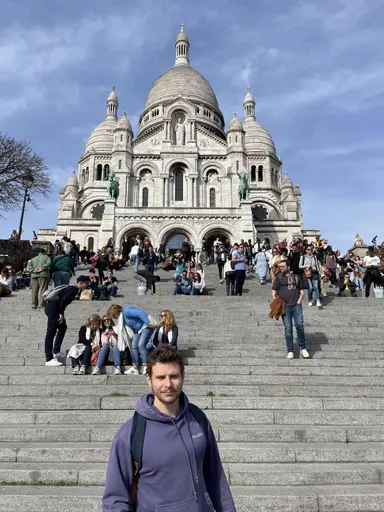
- To see right there: The Sacré-Cœur (obviously), Place du Tertre (for the folklore), and the Montmartre Museum.
- Logistics (Warning!): This is the weak point. Montmartre is off-center (to the North). To reach the Louvre or the Eiffel Tower, count on a good 30 minutes by metro. And above all… it climbs. If you have a stroller or difficulty walking, the stairs will quickly become your enemies.
The budget: €€ You find everything, from small romantic hotels to youth hostels. It is often cheaper than the center because you pay for the metro travel time.
My expert advice: Where exactly to stay?
Montmartre isn’t uniform.
If you have to target a sector, here is the one I recommend most often:
- The Abbesses / Lamarck (West) side: This is the boho, safe, charming, and family-friendly side. This is where you should aim!
It’s perfect for you if:
- You dream of romantic and artistic Paris.
- You have strong calves (I’m serious about the stairs!).
- You don’t mind taking the metro a bit every morning to reach tourist sites.
Batignolles (17th)
Vibe: Parisian village, trendy, family-friendly & relaxed
This is my little favorite, the up-and-coming neighborhood that isn’t talked about enough in classic guides. If you want to see how today’s Parisians live, this is where it’s happening.

Why do we love it? Because it is absolutely quiet in the evening, while being super lively during the day. Batignolles has a small village vibe with its church square, its magnificent park, and its sunny terraces. You feel at home immediately, far, very far from the tourist agitation of the Champs-Élysées… which are actually just next door!
Practical side & monuments:
- To see right there: The Parc Martin Luther King (ultra-modern) and the Square des Batignolles (more classic with its grotto and ducks). It’s paradise for joggers and children.
- Connection: You aren’t in the geographic center, but thanks to Line 14 (Pont Cardinet station), you are at the Louvre in 8 minutes flat. It is this neighborhood’s secret weapon.
The budget: €€ It’s excellent value for money. Hotels are often more modern and spacious than in the Latin Quarter for the same price.
The foodie spot
Rue des Dames and Rue des Batignolles are packed with incredible little bistros that are not tourist traps. You will eat real food there, at a fair price.
It’s perfect for you if:
- You are traveling as a family (the parks are great).
- You want an authentic experience, not just a tourist one.
- You are looking for quiet at night to sleep well.
Canal Saint-Martin (10th)
Vibe: Hipster, festive, photogenic & chill
Remember the scene where Amélie Poulain skips stones? That’s here. The Canal Saint-Martin is the hangout for Parisian thirty-somethings who come to have drinks by the water as soon as the weather is nice.

Why do we love it? For its unique atmosphere. It is less monumental than the Seine, but so much more poetic with its locks and iron footbridges. It’s a neighborhood of creators, sharp coffee shops, and award-winning bakeries (this is where the famous bakery “Du Pain et des Idées” is located—their pistachio-chocolate snail is to die for).
Practical side & monuments:
- To see right there: Strolling along the canal, shopping on Rue de Marseille or Rue Beaurepaire.
- Connection: You are very close to Place de la République, a gigantic transport hub (5 metro lines) that takes you everywhere. The Marais is accessible on foot in 15-20 minutes.
The budget: €€ Prices are decent, but be careful about the type of accommodation. It is a lively and festive neighborhood. If you face directly onto the canal or a popular bar, your summer nights might be… animated.
It’s perfect for you if:
- You are young (or young at heart!) and traveling with friends or as a couple.
- You love photography: the light on the canal at the end of the day is insane.
- You are looking for a neighborhood that moves in the evening for aperitifs.
The Direct Outskirts (Levallois, Clichy)
Vibe: Modern, safe, family-friendly & “The Smart Choice”
Let’s be pragmatic. Sometimes, the budget doesn’t allow for a decent hotel within Paris proper, or you simply need more space (especially with children). This is where the near suburbs come into play.

Forget negative clichés about the Paris suburbs immediately. Levallois-Perret and Clichy are often called the 21st arrondissement. It’s clean, it’s wide, it’s modern, and… it is often much safer than certain tourist corners of Paris at night.
Why do we love it? For the unbeatable value for money. For the price of a tiny room with no elevator in the Latin Quarter, here you get a modern 4-star hotel with a real bathroom and a hearty breakfast. Levallois is particularly chic (very affluent families), while Clichy is more dynamic and transforming.
Practical side & monuments:
- To see right there: No major historic monuments (that’s the trade-off), but pleasant parks and modern shopping centers.
- Connection: This is the key point.
- Levallois: Line 3 drops you at Opéra (Department Stores) in 15-20 minutes.
- Clichy: Line 14 (the automatic rocket!) takes you to Châtelet or Gare de Lyon in less than 10 minutes. That’s faster than if you were staying in Montmartre!
The budget: € It is the most economical option to keep a high standard of comfort.
Good to know for transport
No worries for your trips: since 2025, there is no longer a price difference between Paris and its suburbs. Levallois and Clichy are accessible with the single Île-de-France fare, whether by metro or train/RER. No need to calculate supplements or zones: a single transport ticket is enough for the whole region.
It’s perfect for you if:
- Your budget is tight but you don’t want to sacrifice comfort/cleanliness.
- You are traveling as a family and need a triple or quadruple room.
- You prefer sleeping in a quiet and residential neighborhood.
The Unique Option: Sleeping on the Seine (The Barges)
Vibe: Offbeat, romantic & unforgettable
Want to tell your friends you slept on the Seine? Then forget dry land. Paris has many barges converted into hotels or bed & breakfasts, moored along the quays.

Why do we love it? Because the perspective changes everything. Having your coffee on the deck at sunrise, with the lapping of the water and the monuments in the background, is a unique experience. It is surprisingly calm in the heart of the city (the water absorbs the noise of cars).
Practical side & Locations: Spots vary, but the best quays to stay are generally:
- Quai d’Austerlitz (13th): Very trendy, close to Gare de Lyon and the Jardin des Plantes. Festive atmosphere on weekends with the Cité de la Mode.
- Port de Suffren (7th): At the foot of the Eiffel Tower. It is more expensive, but the view is unbeatable.
The budget: €€ to €€€ It varies greatly. It ranges from a small cozy cabin (average price) to a floating luxury suite (very expensive).
It’s perfect for you if:
- You are looking for an experience out of the ordinary.
- You aren’t claustrophobic (cabins can be tight; it is a boat after all).
- You want to see Paris from another angle, literally floating on the water.
My advice
Check reviews on sound and thermal insulation carefully. In winter, an old, poorly insulated barge can be chilly. Prioritize recent establishments like the OFF Paris Seine (a floating hotel with a pool, incredible in summer) or highly-rated guest barges on Airbnb.
Areas to Avoid for a First Trip
Like all major metropolises (London, New York, Rome), Paris has its shadows, its rough neighborhoods, and its traps.
For a first trip, your priority must be peace of mind. You don’t want to come home at night hugging the walls, nor feel uncomfortable pulling out your phone to check your route.
Here are the places I almost systematically cross off the list when advising loved ones, either for reasons of safety (perceived or real), or for reasons of stress.
| Zone / Neighborhood | Why I advise against it for a 1st time | The main risk |
|---|---|---|
| Gare du Nord / Gare de l’Est (10th) | The immediate surroundings of the stations change face as soon as night falls. It is noisy, agitated, and sometimes sketchy. | Feeling of insecurity, snatch theft, visible street trafficking. |
| Barbès / Goutte-d’Or (18th) | A very working-class neighborhood with crazy energy during the day, but one that can be very intimidating for tourists at night (especially for solo women). | Heavy atmosphere, street harassment, groups hanging around. |
| Porte de la Villette / Aubervilliers (19th North) | Certain sectors (like Rue d’Aubervilliers or near Jardin d’Éole) face visible drug addiction issues (“crack”). | Grim environment, real insecurity at night, far from postcard Paris. |
| Châtelet-les-Halles (1st) | It isn’t dangerous, but it is a machine. It is the ultra-concrete, crowded nerve center. | Intense stress. The metro station is an infernal maze (the worst in Paris) where you walk kilometers underground. |
| Far Suburbs (Seine-Saint-Denis: Aulnay, Clichy-sous-Bois…) | You will see cheap hotels on Booking… run away. It is too far, poorly served at night, and some housing estates are sensitive. | Colossal waste of time (crowded RER B) and potential insecurity coming home late from the station. |
A Note on Safety: Perception Matters
I want to clarify one thing: thousands of people live in Barbès or near Porte de la Chapelle and it goes very well for them; I’ve been there many times myself without any problems. But they know the codes, they know the streets to avoid. As a tourist, with a suitcase, a slightly lost look, and perhaps an approximate command of French, you are an easier target for pickpockets or nuisances.
If you see a hotel offer 10 minutes from Montmartre at a price defying all competition, check the address carefully. If it is Boulevard de la Chapelle or Boulevard Barbès, take a pass this time. You will thank me later.
The Special Case of Châtelet: The Central Trap
Many new visitors say to themselves: Châtelet is the exact center, it’s practical! Yes, it is practical. But it is also the noisiest and most impersonal place in the city. The underground station is gigantic (I’ve lost my own sense of direction there more than once, and I’ve been there more than once!). Returning to Châtelet after a day of romantic walking is like leaving a spa to enter a crowded nightclub. For a first Parisian experience, we prefer charm over brute efficiency.
Golden Rule of Safety
No matter where you stay, be vigilant on Metro Line 1 and in tourist stations. The pickpockets there are professionals. Never leave your phone on the table on a terrace and keep your bag closed in front of you in the metro. It’s common sense, but we forget it quickly when marveling at the city!
Practical Tips for ItineraryFrance Travelers
Before letting you click “Book,” I have a few last tips for you. These are those little details you don’t necessarily think about when looking at pretty photos on Instagram, but which can quickly become grit in the gears once you’re there.
Here is my survival checklist for Parisian accommodation:
The Elevator Enigma: A classic. Many Parisian buildings date from the 19th century (Haussmann style). They are sublime, but often without elevators. Or with a tiny elevator where you barely fit alone without a suitcase.
The test: If the listing says “4th floor without elevator,” ask yourself honestly: are you capable of carrying your 20kg suitcase up after an 8-hour flight? If the answer is no, filter your search.
Air Conditioning is Not Automatic: Unlike in the USA or Asia, AC is an exception in Paris, not the rule (even in some 3-star hotels). If you come in July/August and you fear the heat, check for “AC” or “Air Conditioning.” Otherwise, it will be a fan and open windows (with the street noise that goes with it).
The Hotel Breakfast Trap: Unless it is an incredible brunch included in a special offer, refuse the hotel breakfast if it costs more than €15.
Why? Because for €5, you can go down to the bakery on the corner, get a coffee, a fresh orange juice, and the best croissant of your life still warm. That is the real Parisian experience (and it saves money!).
Book (Very) Early: Paris is one of the most visited cities in the world. The good deals (well-located and cheap) go 4 to 6 months in advance. If you wait until the last minute, you will only have the choice between very expensive or very far.
Budget Tip: The City Tax
Don’t forget to include the tourist tax (taxe de séjour) in your budget. It is often not included in the price displayed on booking platforms and is paid on-site. It has increased in recent years (notably around the Olympics) and remains high. Count on a few euros per night per person extra.
Conclusion: So, Which Neighborhood is Made for You?
Choosing your accommodation in Paris is a bit like choosing your house at Hogwarts: it determines the color of your stay.
- You want romance and History? Go for Saint-Germain or the Marais.
- You want village life and calm? Head to Batignolles or Montmartre (Abbesses side).
- You have a tight budget but want to stay efficient? Opt for the Latin Quarter or bordering towns like Levallois.
The essential thing is to choose a place where you will feel good coming home at night, feet sore but head full of memories. Don’t look for absolute perfection, look for the neighborhood that vibrates at the same frequency as you.
Still hesitating? That’s normal. Between contradictory reviews on TripAdvisor and the fear of making a mistake, it can quickly become a headache. That is exactly why we created ItineraryFrance.
We don’t just give you a list of hotels. We build your stay around you. We analyze your budget, your pace (early bird or night owl?), and your desires to find that rare gem and build the itinerary that goes with it.
Turn this guide into a day-by-day itinerary
Tell me your dates, your pace, and your priorities (Left Bank, Marais, Batignolles...). I help you choose the right base camp and schedule metro trips for a realistic plan.
Bon voyage and welcome (soon) to Paris!
FAQ
What is the best arrondissement in Paris for a first tourist visit?
I often recommend the Marais (3rd/4th) for doing everything on foot, even if prices are high. If your budget is tighter, the Latin Quarter (5th) offers a central and historic alternative that is more affordable. Conversely, for a limitless and very chic stay, head to Saint-Germain-des-Prés (6th).
Which neighborhoods and areas should be avoided in Paris for tourist safety?
For your peace of mind in the evening, avoid the immediate surroundings of Gare du Nord and Gare de l’Est, as well as agitated neighborhoods like Barbès or Porte de la Villette. I also advise against Châtelet for a first stay: it isn’t dangerous, but it is noisy, concrete-heavy, and the underground station is an exhausting maze.
Where to sleep in Paris to experience local life far from the tourist crowd?
My favorite for living “like a local” is the Batignolles (17th) neighborhood: a family village vibe in the quiet, connected to the Louvre in 8 minutes by Line 14. Otherwise, target the West side of Montmartre (Abbesses) for romantic charm, far from the tourist crush of the Sacré-Cœur.
Where to stay in Paris for good value without being too far out?
If the center is too expensive, dare to try the near suburbs in Levallois or Clichy: it is modern, safe, and you will often get a real bathroom for less money. Thanks to lines 3 and 14, you reach the heart of Paris faster than from certain neighborhoods inside the city walls.
Is it better to stay near monuments or a strategic metro line?
Above all, do not choose your accommodation for the Eiffel Tower view: the neighborhood is often poorly connected and very quiet at night. Absolutely prioritize a good metro connection (ideally Line 1 or 14): it is better to be 15 minutes from everything by transport than stuck at the foot of a monument.